
Tailoring Guide
From Fabric to Finished Kameez
What to ask your tailor, how a good kameez should fit, and the small calls that turn 4.5 metres of fabric into a kameez you'll wear for three years.
Buying the right fabric is half the job. The other half lives in the tailor's shop. This guide is the conversation we wish every man had with his tailor before the first cut — what to specify, what to measure, what to leave to the tailor's judgement, and how to spot a cut that's wrong before you walk out with it.
01 — Kameez Cuts
Pick the cut before you pick the colour.
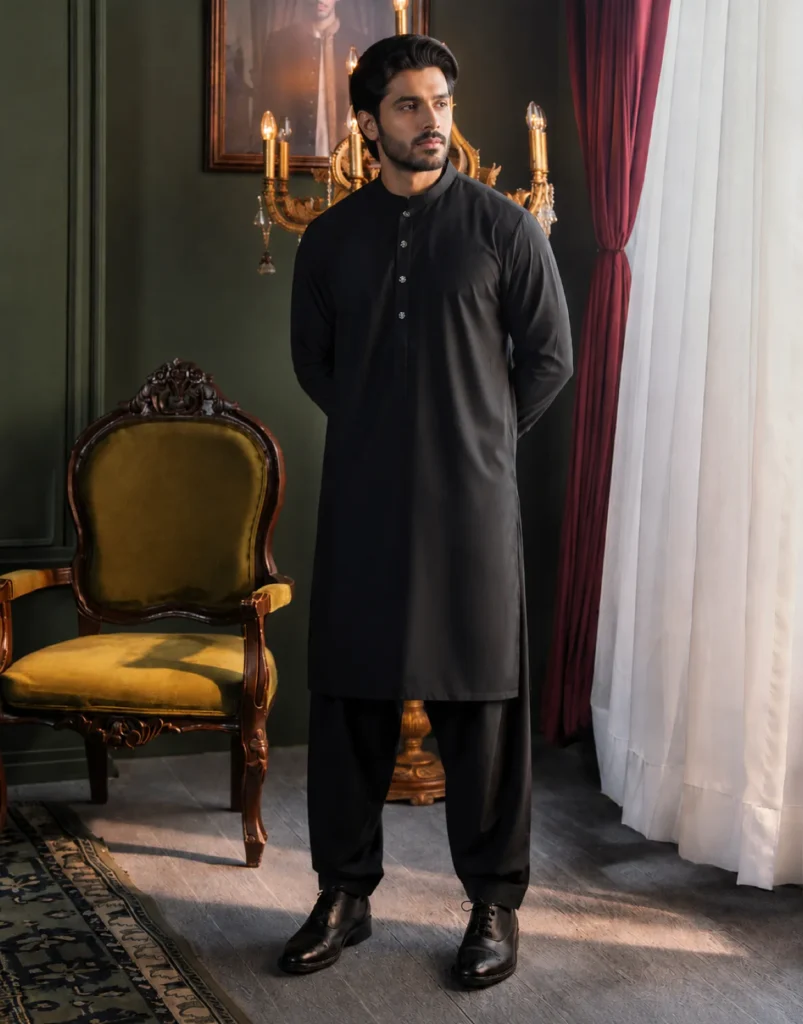
Three kameez cuts cover 95% of what Pakistani men actually wear. Knowing them by name saves a 20-minute conversation with your tailor.
- A-line (regular): Standard cut, slightly flared from chest to hem. Most forgiving on most builds.
- Straight cut: Same width chest to hem. Reads modern, formal, slightly slimmer.
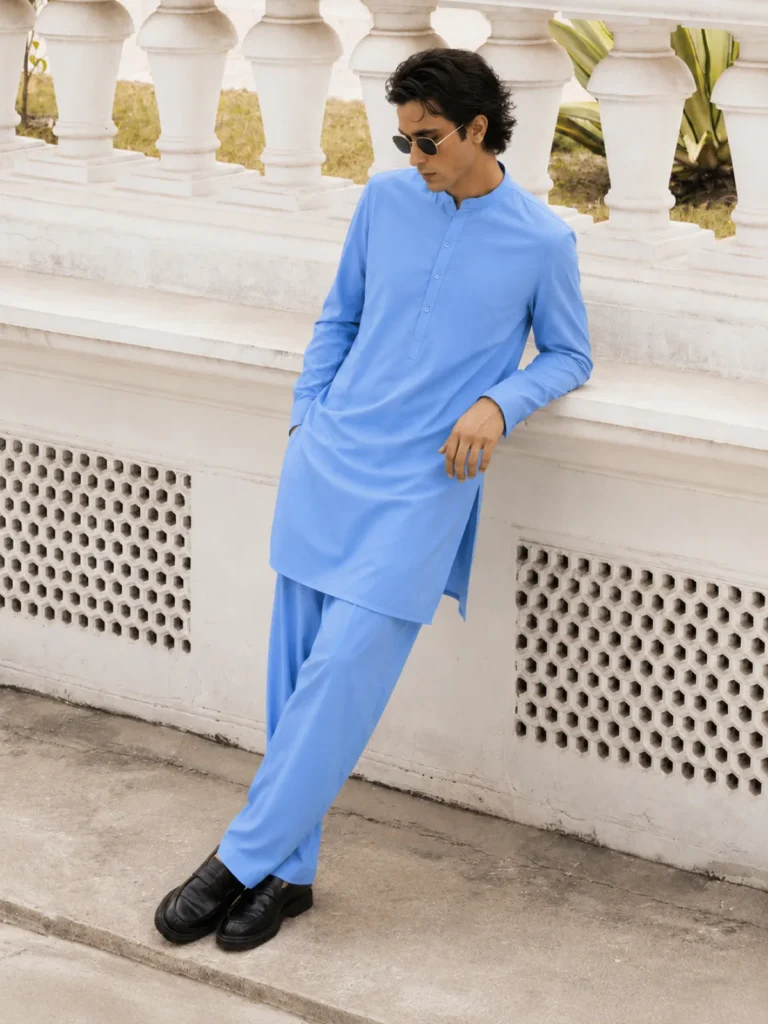
- Pathani / kurta cut: Hip-length, shorter than a kameez. Worn with churidar or jeans. Casual.
- Sherwani cut: Longer (knee-length), structured shoulders, higher collar. Formal occasions only.
- Best for SHA LIBAS Cotton/W&W: A-line or straight cut for daily wear.
- Best for SHA LIBAS Grace: Straight cut for occasion wear, sherwani cut for weddings.
02 — The Measurements
Eight numbers your tailor needs.
If you've never had a tailor measure you, ask for these eight specifically. If you have, double-check them — bodies change, and a measurement from 2023 may be off today.
- Chest: Around the fullest part, arms relaxed at your sides
- Waist: At your natural waistline (slightly above the navel)
- Hip: Around the widest part of your hips
- Kameez length: From shoulder seam to where you want it to end (knee, mid-thigh, or hip)
- Sleeve length: From shoulder edge to wrist bone (with a 1cm cuff allowance)
- Shoulder width: Bone to bone across the back
- Shalwar length: From waist to ankle (no shorter — Pakistani shalwar covers the ankle)
- Shalwar mori (cuff): The width of the ankle opening — 6 to 8 inches is standard
03 — How a Good Kameez Should Fit
Five fit checks before you walk out.
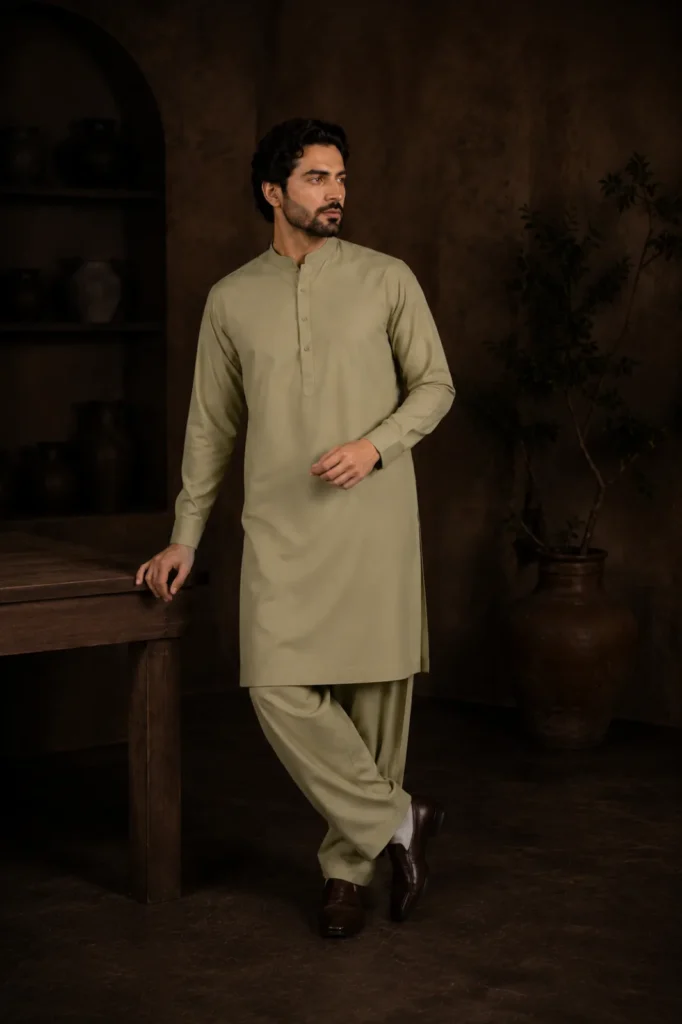
When you collect the kameez from the tailor — before you pay — try it on and run these five checks. A good tailor will fix any of them on the spot.
- Shoulder seam: Sits exactly at the edge of your shoulder bone — not on your arm, not pulled inward
- Sleeve: Ends at the wrist bone with about 1 cm of room — should not crawl up when you raise your arm
- Chest: Pinch the kameez at the chest — about 2 fingers' worth of fabric should pinch comfortably
- Length: Front and back hems should be even — uneven hems mean a poorly cut pattern
- Collar: Sits flat against the back of the neck — no gaping, no choking
04 — The Small Decisions
Details that change how the kameez wears.
These are the calls your tailor will make for you if you don't specify. Take 2 minutes to specify them — the kameez will fit your life better.
- Collar style: Ban (mandarin / Nehru) for formal · Open (turn-down) for casual · Hidden placket for clean modern
- Pockets: Two side pockets standard · Add chest pocket if you want one (be specific)
- Buttons: Hidden placket (clean modern) · Visible buttons (traditional) · 5 button minimum, 7 for longer kameez
- Side slits: Standard 6-inch slits at the hem · Longer slits = more movement, less formal
- Cuff style on shalwar: Plain (most common) · Pleated (slightly more structured)
- Lining: Inside collar + inside placket should always be lined for stiffness
What to ask vs what to leave alone
| Specify it | Trust the tailor | |
|---|---|---|
| Cut style | A-line / straight / sherwani | — |
| Kameez length | Knee / mid-thigh / hip | — |
| Collar type | Ban / open / hidden | — |
| Pockets | Side + chest yes/no | — |
| Buttons | Hidden / visible | Stitching technique |
| Side slits | — | Standard 6 inch |
| Seam allowance | — | Tailor's call |
| Inner lining | — | Tailor's call |
Common questions
How much does it cost to stitch a shalwar kameez in Pakistan in 2026?
PKR 2,000–3,500 for standard tailors in major cities. Premium boutique tailors charge PKR 4,000–8,000 with detail work and faster turnaround. Sherwani stitching is PKR 5,000–15,000 depending on detail.
How long does it take a tailor to stitch a shalwar kameez?
3–7 days for a standard tailor. 2 days express for a small premium. Always ask up front — the answer "kal mil jayega" usually means 4 days.
What should I bring to the tailor with my fabric?
The fabric (4.5m, pre-cut from SHA LIBAS), a reference photo if you want a specific style, and an existing kameez that fits you well — your tailor can use it as a measurement reference. Bring your phone with this guide open.
Can my tailor stitch from an old kameez as a reference?
Yes — and it's the easiest way to get a perfect fit. Take an old kameez that fits well and ask your tailor to "use this as the size." Most tailors prefer this to taking fresh measurements.
How do I find a good tailor?
Ask three people whose kameez fits well where they get them stitched. The same three names will come up — that's your shortlist. Avoid tailors who don't ask you to come in for a fitting before final stitching; that's the single biggest predictor of a bad result.
What if the kameez doesn't fit when I collect it?
Don't pay until it fits. A good tailor will alter on the spot or in 24 hours. If a tailor refuses to alter a clear fit issue (loose chest, short sleeve, uneven hem), find a different tailor for next time — they're not worth your fabric budget.